How to Prepare Your Teen for a Traffic Stop: A Step-by-Step Safety Talk
Let’s be real for a second. The scariest part of parenting a new driver isn’t the parallel parking. It’s the moment you hand over the keys and realize you can’t control what happens out there. The world is full of potholes, distracted drivers, and… yes, traffic stops.
For a teen, getting pulled over isn’t a routine inconvenience; it’s a pop quiz in a subject they’ve never studied, with their heart hammering as the soundtrack. They’re thinking about what they did wrong, if they’ll get a ticket, and what you’re going to say. They are not thinking calmly about their constitutional rights.
That’s where you come in. This isn’t about teaching them to “beat the system.” It’s about giving them a simple, calm script so they don’t freeze up. It’s about trading panic for a plan. Think of this as the most important driving lesson you’ll ever give—one that has nothing to do with a turn signal.
So, grab a couple of sodas, sit ‘em down, and let’s turn this daunting talk into a practical, empowering game plan. Here’s your step-by-step guide.
Step 1: Set the Stage (And Lose the Doom & Gloom)
Goal: Normalize the conversation. Make it about smart preparation, not scary possibilities.
Your Opening Line (Try One of These):
“Okay, so we’ve mastered the three-point turn. Now let’s talk about the one thing every driver will experience eventually: seeing those flashy blue lights in the rearview mirror. It’s not an ‘if,’ it’s a ‘when,’ and it’s no biggie if you’re prepared.”
“I need to update your driver’s ed curriculum. They covered what to do at a four-way stop. Let’s talk about what to do when a cop stops you at one.”
The Key Reframe: Position this as a life skill, like knowing how to change a tire or file taxes. It’s about competence, not crime. Emphasize that good, safe drivers get pulled over for simple stuff like a burnt-out license plate light all the time. This isn’t about “getting in trouble”; it’s about “handling a situation.”
Step 2: Paint the Picture – The “When You See Blue Lights” Drill
This is the muscle memory part. Walk them through the exact physical sequence.
The 30-Second Safe Setup:
Signal & Slide Over. Right turn signal on. Slow down smoothly. Aim for the nearest safe, well-lit spot (a parking lot is better than a narrow shoulder). This shows the officer you’re being cautious and considerate.
Park & Power Down. Car in park. Engine off. This eliminates any accidental rolling and reduces tension.
Light It Up. If it’s dusk or dark, immediately turn on your interior dome light. This is a huge, non-verbal gesture of goodwill. It says, “I have nothing to hide, and I want you to feel safe approaching.”
Hands on 10 and 2. Place your hands on the top of the steering wheel. Take a deep breath. This is the “neutral ready” position. It keeps your hands visible and prevents any sudden, nervous movements that could be misinterpreted.
Why This Matters: This initial drill does 80% of the work. It immediately de-escalates the situation, shows respect for the officer’s safety, and gives your teen a concrete list of actions to focus on instead of their racing thoughts. It turns “Oh no, what do I do?!” into “Okay, signal, pull over, park, light, hands. Got it.”
Step 3: Introduce the B.R.A.V.E. Conversation Script
Now for the interaction itself. We’re going to use an easy-to-remember acronym: B.R.A.V.E. Not because they need to be heroic, but because they need to be Balanced, Respectful, Aware, Vocal (when needed), and Empowered.
B – Breathe and Be Present.
Remind them: The officer is probably just doing their job. A quick, quiet deep breath before the window comes down can lower their heart rate and steady their voice.
R – Reach Slowly for Documents.
Only when asked. They should say something like, “Sure, my license and registration are in my glove compartment. Is it okay if I reach over to get them?” This is polite and keeps the officer informed of their movements.
A – Answer Minimally (Or Not at All).
This is the big one. Here’s the script:
For basic questions (name, etc.): Answer politely.
For “Do you know why I stopped you?”: It’s okay to say, “No, sir/ma’am, I don’t.” Don’t guess or admit to anything.
For fishing questions (“Where are you headed?” “Have you had anything to drink tonight?”): This is where their right to remain silent kicks in. They can say politely, “I’m choosing to remain silent on that.”
Parent Pro-Tip: Rehearse this line! It feels weird to say. Practice in the car until it feels more natural. Emphasize it’s not rude; it’s a smart, legal choice.
V – Verbally Deny a Search (If Asked).
Officers may ask, “Do you mind if I take a look around your car?” They are asking for consent. Your teen should know the magic, polite phrase: “Officer, I do not consent to a search.”
Why this is crucial: This protects their 4th Amendment rights. A search without consent or probable cause is generally not legal. Saying “no” is not an admission of guilt; it’s a protection of privacy. It’s simply saying, “I know my rights.”
E – End the Stop Calmly.
Once the officer hands back their documents and gives instructions (a warning, a ticket), the response is simple: “Okay. Thank you, officer.” Wait for the officer to clearly walk back to their car before starting the engine, signaling, and merging safely back into traffic.
The Debrief Call. Make a promise: “Your first call after any stop is to me, no matter what. No yelling, no lectures in that moment. We’ll figure it out together.” This ensures they always feel safe coming to you.
Step 4: Role-Play! (Yes, Really.)
Knowledge is one thing. Practice is everything. Head out to the driveway.
You be the officer. Walk up to the driver’s side window. Run through different scenarios: a simple taillight stop, a more serious speeding stop, asking where they’re coming from, asking to search the car.
Let them run the drill. Signal, pull over, dome light, hands on wheel. Have them practice the scripts: asking to reach for their wallet, saying “I choose to remain silent,” and “I do not consent to a search.”
Keep it light. Laugh if it feels awkward. The goal is to make the words feel familiar in their mouth, so in a real situation, they can come out on autopilot.
Step 5: Equip Their Digital Toolbox – The Modern Safety Net
Here’s the 21st-century part of the talk. We have tools our parents didn’t. Frame this as their “digital seatbelt.”
The Problem with Just a Phone: In a stressful moment, fumbling to open a camera app, hit record, and hope the video saves is hard. What if the phone is taken or dies? The stress of recording can sometimes add to the tension.
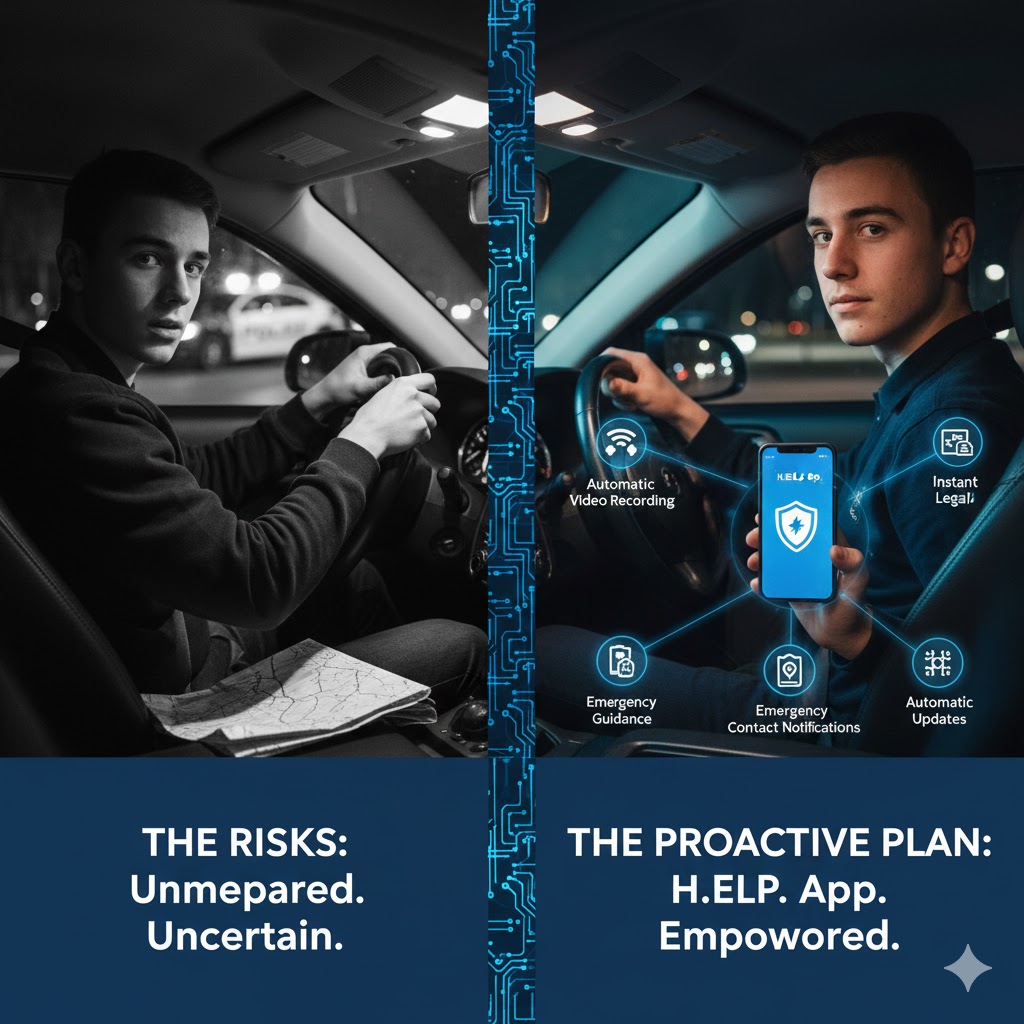
The Smarter Solution – The H.E.L.P. App: This is where we can talk about a tool designed specifically for this moment. It’s like a “black box” for interactions.
The One-Tap Advantage: Explain that with an app like H.E.L.P. App, they can put a shortcut right on their home screen. One tap, discreetly, as they’re pulling over. That single tap starts an audio recording, logs the GPS location, and—most importantly—instantly saves it to a secure cloud. Even if something happens to the phone, the record is safe.H
The “Trusted Contact” Superpower: The best part? That same one tap can send a silent, instant alert to your phone (and another parent or trusted adult): “Kai’s H.E.L.P. App is active. Location secured.” Now, you’re not sitting at home wondering why they’re late. You know they’re in an interaction, and an objective record is being made. This transforms your worry from frantic to informed.
It’s For Their Empowerment: Position this not as you spying, but as them having their own impartial witness. It’s a tool that says, “I am documenting this for clarity,” which can actually make everyone involved more professional. It’s a shield for them, and peace of mind for you.
The Final Pep Talk
Wrap it all up with this:
“Look, the goal of all this isn’t to make you afraid of the police. Most officers are decent people doing a tough job. The goal is to make you confident in yourself. You have rights. You have a plan. You have tools. So if that day comes, you won’t be a nervous wreck—you’ll be a prepared, respectful, and informed driver. That’s the real mark of being a good driver. Now, who wants pizza?”
By having this talk, you’re not preparing them for the worst. You’re empowering them for reality. You’re replacing fear with preparedness, and anxiety with a plan. And that’s one of the greatest gifts you can give a new driver—and yourself.
Ready to make the plan concrete? Download our free, printable B.R.A.V.E. script checklist to keep in the glove compartment, and explore how a digital tool like the H.E.L.P. App can be the silent guardian on every car ride. For more on your teen’s specific legal rights, the ACLU’s Teen Rights Center is a fantastic resource, and for general safe driving stats, TeensDriveSafe.net offers great, non-scary educational materials.