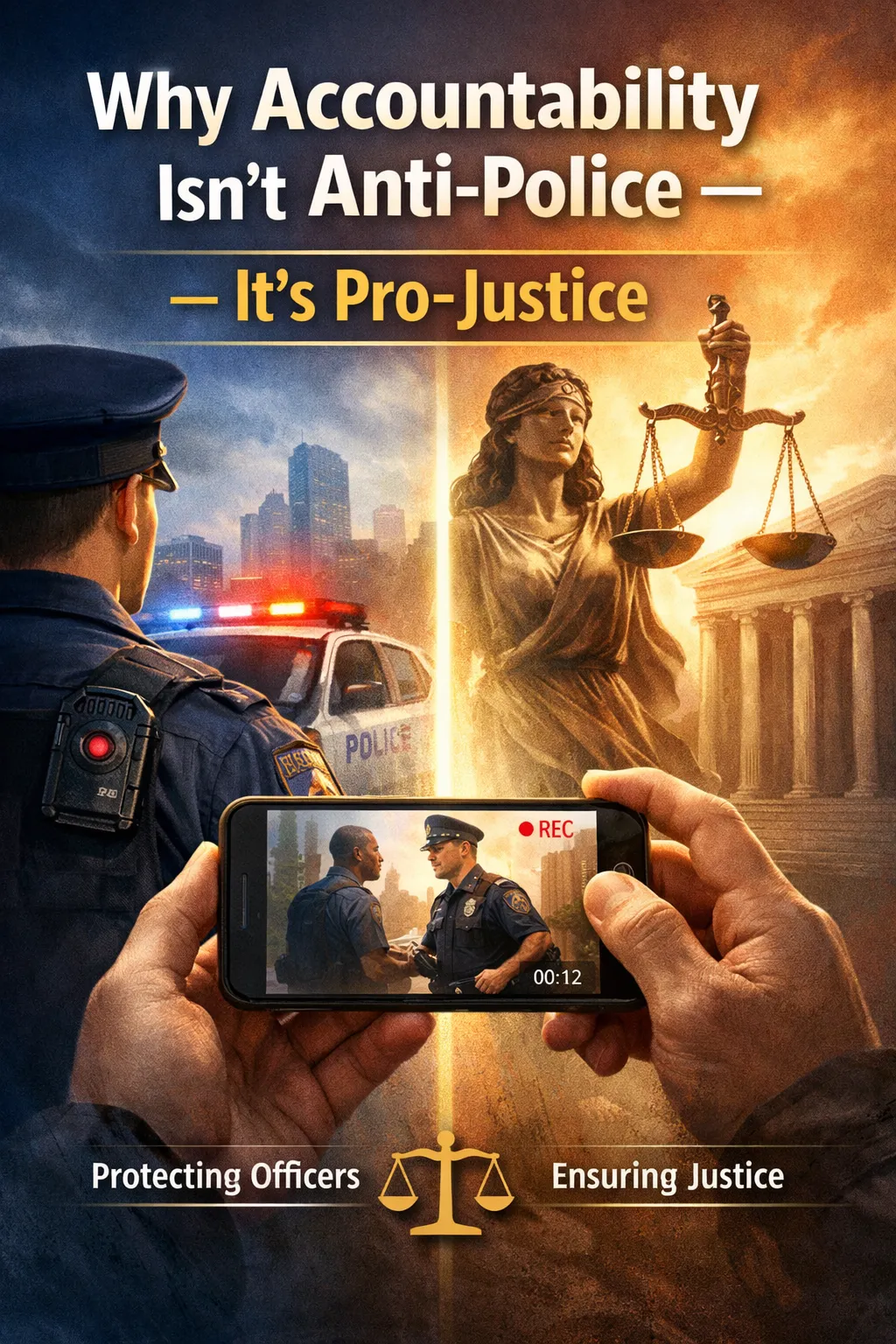
Why Accountability Isn’t Anti-Police — It’s Pro-Justice
Few phrases trigger faster reactions than “police accountability.” For some, it sounds like blame. For others, it sounds like protection. The truth is far less dramatic and far more practical. Accountability is not anti-police. It is pro-justice. And justice works best when everyone involved is protected by clarity, evidence, and fairness.
In everyday life, accountability is a normal expectation. Teachers grade papers. Doctors document charts. Businesses track transactions. None of this implies wrongdoing. It implies professionalism. Policing is no different. When accountability is built into systems, it strengthens trust, improves outcomes, and protects both officers and civilians from misunderstandings that can spiral out of control unnecessarily.
As discussed in Why Accountability Starts the Moment an Encounter Begins documentation works best when it begins early—not after tension rises.
This article explains why accountability is not an attack on law enforcement, how it actually supports good policing, and why modern tools exist to protect everyone involved in an encounter. The goal is not outrage. It’s understanding. Because justice doesn’t thrive on division—it thrives on truth.
Why Accountability Gets a Bad Reputation
The word accountability is often introduced only after something goes wrong. Headlines, protests, and investigations dominate the conversation. That framing makes accountability feel punitive rather than preventative.
But accountability itself is neutral. It doesn’t assume guilt. It preserves facts so truth can be evaluated later.
The problem isn’t accountability. It’s when accountability is missing.
Organizations like the ACLU regularly emphasize that transparency strengthens lawful policing, not weakens it
Why Accountability Is a Sign of Professionalism
In any profession, accountability signals seriousness. Surgeons document procedures. Pilots log flights. Engineers track inspections. These records don’t insult competence. They demonstrate it.
Policing is one of the most complex professions in society. Documentation supports that complexity.
Modern accountability increasingly relies on technology. The National Institute of Justice highlights how technology strengthens justice systems and improves policing practices
Why Good Officers Benefit the Most
Officers who follow protocol benefit enormously from accountability. Clear records protect them from false accusations, misinterpretation, and rumor.
Evidence doesn’t just expose wrongdoing. It confirms integrity.
This shift toward evidence-based protection reflects what we explored in The Power Shift: When Citizens Have Evidence, Not Just Stories When documentation exists, truth becomes measurable—not debatable.
Why Justice Requires Records
Justice depends on facts. Facts depend on records. Records depend on accountability.
Remove any piece, and justice weakens.
Courts don’t rule on feelings. They rule on evidence. Agencies like the Department of Justice Civil Rights Division rely on documented facts when reviewing complaints and enforcing federal protections
Documentation is not hostility. It is infrastructure.
Why Technology Strengthened Accountability
Modern technology didn’t create accountability. It made it practical in real time.
Smartphones changed what’s possible. As outlined in The Hidden Power of Timestamped Video Evidence time-stamped recordings preserve tone, sequence, and context—three elements memory alone cannot reliably reconstruct.
The Electronic Frontier Foundation also affirms the importance of transparency and recording in public spaces as a safeguard for constitutional rights
Evidence is better than debate. Debate polarizes. Evidence clarifies.
Why Accountability Protects Both Sides
Accountability helps innocent civilians. It also helps officers acting lawfully.
Without records, allegations rely on memory and emotion. With documentation, claims can be evaluated objectively.
Objective evaluation is fair evaluation.
This principle becomes especially important in situations like vehicle searches, where understanding rights clearly can prevent escalation. For example, knowing What Civil Rights Look Like in a Smartphone Era helps individuals remain calm while ensuring facts are preserved accurately.
Why Accountability Prevents Escalation
When interactions are documented, behavior often moderates naturally. People—on both sides—are less likely to escalate when they know actions are preserved.
Visibility encourages restraint.
Clear systems reduce uncertainty. Reduced uncertainty lowers tension. Lower tension saves lives.
Accountability is not about punishment. It is about prevention.
Why Accountability Builds Legitimacy
Legitimacy grows when systems show their work.
Communities want clarity, not conflict. They want to know what happened—not argue endlessly.
Transparent systems build long-term trust. Trust fosters cooperation. Cooperation makes policing safer and more effective.
Accountability is not anti-police. It supports lawful authority by clarifying truth.
Scrutiny strengthens legitimacy.
Why Accountability Is About Systems, Not Individuals
Accountability improves systems. Better systems produce better behavior.
It is a tool—not a weapon.
When records exist, defensiveness fades. Facts calm emotions. Clear documentation reduces litigation, speculation, and rumor.
Shared benefits strengthen institutions.
Why Accountability Is Pro-Justice
Justice isn’t about winning arguments. It’s about getting things right.
Justice requires truth. Truth requires evidence.
Accountability preserves both.
It protects officers who do their jobs well. It protects civilians who deserve fairness. It protects communities who rely on lawful systems.
That isn’t anti-police.
It’s pro-justice.
Final Thoughts
Accountability is not an accusation. It is a foundation.
It protects officers, civilians, and communities by preserving facts instead of arguments. When accountability exists, justice works better—for everyone.
The future of policing isn’t less accountability. It’s better accountability. And that future is pro-justice, not anti-police.
Take the Next Step
If you believe justice is strongest when truth is preserved calmly and fairly, choose tools built for accountability.