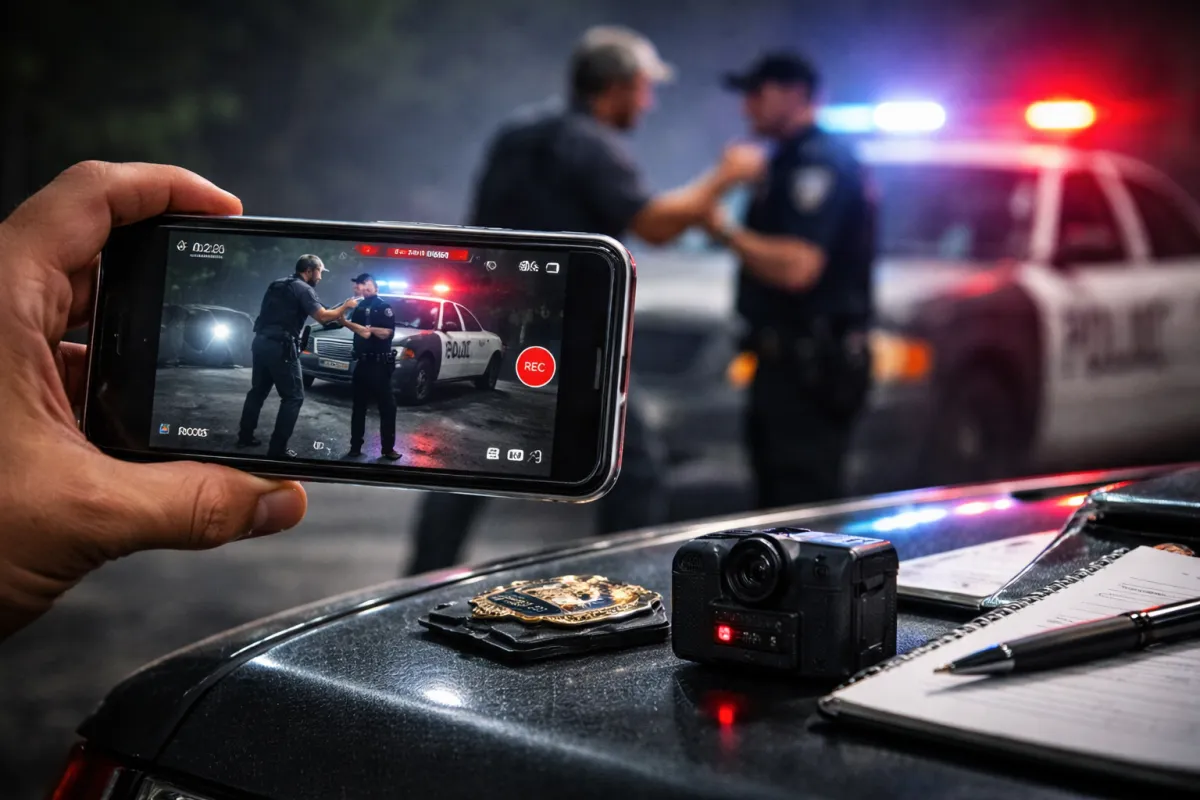
How One Recording Can Clarify an Entire Encounter
High-stress moments feel loud while they’re happening—and blurry afterward.
A traffic stop.
A heated exchange.
An unexpected confrontation.
In the moment, everything feels intense. Later, everything feels uncertain.
Who spoke first?
Was the tone calm or aggressive?
Did someone escalate—or try to de-escalate?

When memories don’t align, confusion takes over. And confusion has consequences.
One clear, uninterrupted recording can clarify an entire encounter.
Not multiple clips. Not commentary. Not a social media debate.
Just a continuous, timestamped record of what actually happened.
In disputes that often become “my word versus yours,” a single recording replaces emotion with evidence and speculation with sequence.
Why Encounters Feel Different After They End
During tense situations, adrenaline rises. The brain focuses on reaction and safety—not perfect recall.
Later, memory reconstructs events. It fills gaps. It emphasizes emotional peaks. Sometimes it unintentionally softens or exaggerates details.
Two people can leave the same encounter with completely different recollections—both feeling certain.
But courts, employers, and oversight bodies require structure and verification.
That structure comes from documentation.
Why Sequence Matters More Than Emotion
In most encounters, what matters most is order.
Was a lawful instruction given before resistance?
Did someone attempt to de-escalate first?
Did tension rise gradually or suddenly?
Without sequence, people argue over fragments.
With sequence, the story becomes clear.
A continuous recording preserves beginning, middle, and end. That continuity changes outcomes.
For a deeper look at how time anchors credibility, see The Hidden Power of Timestamped Video Evidence.
Why Tone Is Often Misremembered
Tone can transform meaning.
A calm instruction feels different from a shouted demand.
A measured response carries different weight than a hostile one.
Written reports summarize tone. Recordings preserve it.
And tone often shapes perception as much as words themselves.
Why Small Details Become Big Disputes
Encounters often hinge on details:
Whether someone interrupted
Whether compliance was immediate
Whether warnings were given
Whether personal space was respected
In the moment, these seem minor. Later, they become pivotal.
One clear recording preserves those details without interpretation.
Why Evidence Reduces Escalation Afterward
When accounts conflict, disputes escalate. Complaints grow. Defensiveness increases.
But when evidence exists, the conversation shifts.
Instead of debating perception, people review facts.
As discussed in Why Transparency Protects Truth — Even When Memories Don’t Match, transparency stabilizes outcomes. Facts reduce emotional escalation.
How One Recording Protects Both Sides
Recording does not automatically favor one side.
It can confirm misconduct.
It can also confirm professionalism.
Clarity protects everyone.
When behavior is appropriate, evidence proves it.
When boundaries are crossed, evidence reveals it.
Transparency strengthens accountability.
Why One Continuous Recording Is Better Than Fragments
Short clips taken out of context can mislead. Edited snippets invite interpretation.
A full, uninterrupted recording preserves context.
Context prevents distortion.
This is especially important in post-incident review, as explained in What Happens After the Camera Stops Rolling? The Role of Evidence.
Why Timestamps Strengthen Credibility
Time matters.
Did events unfold in seconds or minutes?
Were pauses present?
Was escalation gradual?
Timestamps anchor events to reality.
The H.E.L.P. App (Helping Ensure Legal Protection) integrates secure, timestamped documentation so the sequence remains intact and verifiable.
Anchored time protects truth.
Why Backup Matters
Recording alone is not enough if the file disappears.
Phones break. Data corrupts. Files get deleted.
Secure cloud backup ensures documentation survives beyond the device.
Preservation equals protection.
Why Clarity Changes Outcomes Quietly
Not every clarified encounter makes headlines.
Most resolutions happen quietly:
A citation dismissed
A complaint resolved
A misunderstanding corrected
A reputation restored
Clarity often works behind the scenes. Quiet justice still matters.
Why Recording Encourages Better Behavior
When participants know documentation exists, behavior often improves.
Voices lower.
Instructions become clearer.
Boundaries are respected.
Recording doesn’t just clarify afterward—it influences conduct in real time.
Visibility encourages professionalism.
Why Clarity Supports Civil Rights
Civil rights are not enforced by memory alone. They are enforced by proof.
Documentation clarifies whether:
Rights were respected
Authority was exercised properly
Legal boundaries were crossed
For broader legal context, the ACLU’s Know Your Rights guidance and the Electronic Frontier Foundation’s overview of recording in public provide helpful public resources.
Clarity strengthens due process.
Why Recording Is Not Anti-Authority
Transparency does not undermine lawful authority.
Professionals benefit from documentation just as much as civilians do. Evidence validates proper conduct. Validation builds trust.
When disputes are resolved through proof rather than speculation, public confidence grows.
Why Calm Documentation Is More Effective Than Confrontation
Recording is not about arguing in the moment.
It is about preserving facts for later review.
Calm documentation avoids escalation while protecting your interests. Preparation reduces regret.
Accountability often begins at the very start of an interaction, as explored in Why Accountability Starts the Moment an Encounter Begins.
Why One Recording Can Change the Narrative
Narratives shift based on perspective. Evidence recenters the story around reality.
One recording can:
Confirm compliance
Clarify tone
Demonstrate de-escalation
Reveal procedural accuracy
Correct inaccurate reports
Sometimes, one piece of evidence resolves everything.
Clarity is not confrontational. It is foundational.
Final Thoughts
Encounters end.
Adrenaline fades.
Memories shift.
But one clear recording preserves reality exactly as it unfolded.
It protects dignity.
It clarifies sequence.
It supports fairness.
And when clarity exists, justice has a stronger foundation.
Take the Next Step
If you believe important moments should never rely on memory alone, use tools designed to preserve facts calmly and securely.
Download the H.E.L.P. App here
Clarity today can prevent conflict tomorrow.

