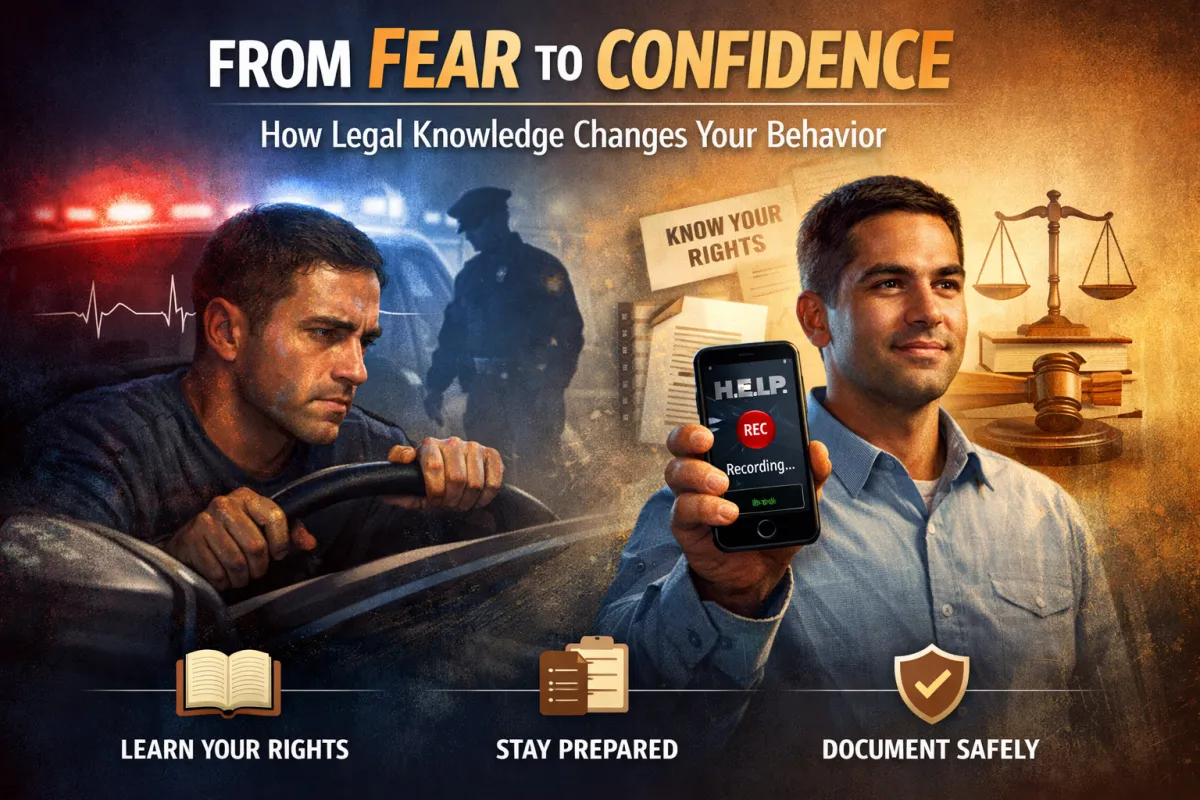
From Fear to Confidence: How Legal Knowledge Changes Your Behavior
Fear is powerful.
It tightens your chest.
It speeds up your breathing.
It scatters your thoughts.

During a traffic stop or unexpected police interaction, fear can take over quickly.
But fear is often rooted in uncertainty — not immediate danger.
When you don’t know your rights, what to say, or what happens next, your mind fills in worst-case scenarios.
Knowledge changes that.
Confidence is not something you feel first. It’s something you build through preparation, clarity, and understanding.
Why Fear Feels So Immediate
Your brain is wired for survival.
When flashing lights appear, your nervous system activates instantly:
Heart rate increases
Muscles tense
Attention narrows
This reaction is biological.
The issue isn’t fear itself. The issue is how you respond to it.
How Uncertainty Fuels Anxiety
Imagine two drivers pulled over for the same reason.
Driver A doesn’t know their rights. They worry about saying the wrong thing.
Driver B understands what they must provide and what they can lawfully decline.
Same situation. Different internal experience.
Uncertainty expands fear.
Clarity reduces it.
For a practical guide, read:👉 How to Stay Calm, Clear, and Protected During Police Encounters
How Legal Knowledge Changes Body Language
When you feel unsure, your body shows it:
Fidgeting
Rapid speech
Avoiding eye contact
Officers are trained to observe behavior. Anxiety can sometimes be misread.
When you understand your rights, your movements slow.
Your breathing steadies.
Your tone becomes measured.
Confidence changes perception.
Why Preparedness Creates Mental Shortcuts
Under stress, improvisation is difficult.
Preparation creates mental scripts.
For example:
If asked, “Do you know why I stopped you?”
You can respond calmly:
“I’m not sure.”
If asked for consent to search:
“I do not consent.”
These short, respectful responses prevent over-talking and reduce escalation.
Learn more about readiness here:👉 Safety Isn’t About Arguing — It’s About Being Ready
Calm Confidence vs. Loud Defiance
Confidence is not confrontation.
You can:
Assert your rights respectfully
Remain silent calmly
Document without escalating
Volume increases tension.
Clarity reduces it.
Why Documentation Strengthens Confidence
Internal confidence comes from knowledge.
External confidence comes from preservation.
The H.E.L.P. App (Helping Ensure Legal Protection) supports that preservation through:
One-tap activation
Secure cloud storage
Timestamped recordings
Reliable evidence retention
When events are documented, memory is no longer your only safeguard.
Documentation replaces uncertainty — and uncertainty is where fear thrives.
For deeper insight into transparency, see:
👉 From Dispute to Documentation: Why Transparency Wins in the End
Why Timestamps Matter
Time is often disputed after encounters.
Did compliance happen immediately?
Were instructions clear?
Did escalation occur first?
Timestamps eliminate ambiguity.
Ambiguity feeds doubt.
Clarity reduces anxiety.
Why Cloud Backup Creates Psychological Safety
Even if you record, fear can remain if you worry the file could disappear.
Secure cloud preservation ensures:
Files remain intact
Evidence remains accessible
Integrity is maintained
Preservation builds calm.
Why Knowledge Reduces Over-Talking
Fear often causes excessive explanation.
People:
Guess
Fill silence
Volunteer unnecessary information
Knowledge creates restraint.
When you understand your legal boundaries, you speak deliberately — not defensively.
Breathing: The Bridge Between Fear and Control
Even with preparation, your body may react.
Use structured breathing:
Inhale for four seconds
Hold for four seconds
Exhale for four seconds
Repeat.
Breathing signals to your brain that the situation is manageable.
Manageable situations feel less threatening.
Why Legal Boundaries Lower Panic
Fear often comes from imagining unlimited authority.
But authority operates within legal limits.
Understanding:
What is required
What is optional
What may be declined
Replaces intimidation with clarity.
For foundational guidance, consult:
ACLU – Know Your Rights
Electronic Frontier Foundation – Recording in Public
Why Confidence Supports Legal Credibility
If an encounter is reviewed later, demeanor matters.
Calm individuals appear credible.
Escalation weakens position.
Confidence protects long-term outcomes.
If you ever feel unsafe during a stop, this guide may help:
👉 The Most Important Thing to Do When You Feel Unsafe During a Stop
Why Knowledge Protects Mental Health
After tense encounters, uncertainty leads to rumination:
“Did I say the wrong thing?”
“Did I respond correctly?”
When you understand your rights and preserve documentation, doubt decreases.
Clarity prevents replay.
Confidence preserves peace of mind.
Why Rehearsal Builds Real Confidence
Practice saying:
“I’m cooperating.”
“I prefer not to answer.”
“I do not consent.”
Practice controlled breathing.
Practice slow, deliberate movements.
Repetition builds familiarity.
Familiarity builds stability.
Confidence grows through preparation — not bravado.
Final Thoughts: The Shift Is Deliberate
Fear is human.
But fear does not have to control you.
Knowledge narrows uncertainty.
Preparation builds mental shortcuts.
Documentation preserves clarity.
Breathing stabilizes emotion.
The shift from fear to confidence is not dramatic.
It is deliberate.
Learn your rights.
Practice calm responses.
Prepare your tools.
When an encounter occurs, you won’t react impulsively.
You will respond intentionally.
Confidence protects you.
Knowledge empowers you.
Preparedness transforms fear into control.
Take the Next Step
If you want to move from uncertainty to clarity, consider equipping yourself with tools designed to preserve documentation and support responsible preparedness.

